

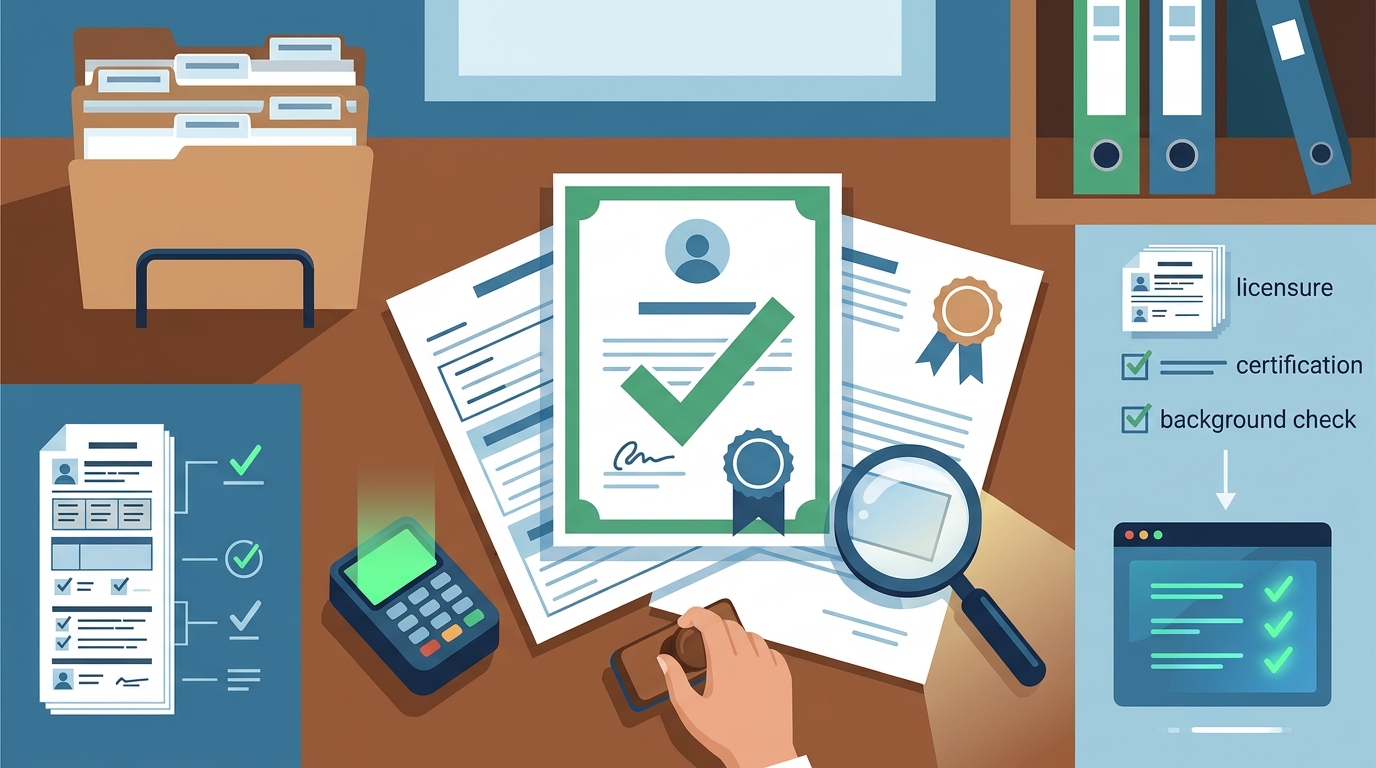
Verify in-home caregiver qualifications by checking state licensing boards, requesting current certification cards, and confirming background check results. CareLinx simplifies this process by pre-screening all providers through a rigorous verification system that includes multi-step behavioral interviews and comprehensive background checks before they can connect with families.
Understand the Difference Between Licensed and Certified Roles
Many families confuse different care roles, which can lead to hiring the wrong professional for their needs. A Registered Nurse (RN) is a licensed healthcare professional who holds a state-issued license after passing a national board exam and completing clinical training. In contrast, a Certified Nursing Assistant (CNA) is a caregiver who has completed a state-approved training program and passed a competency exam to receive a certificate. Understanding these distinctions is critical because the scope of practice varies significantly between these roles. For example, an RN can administer medications and perform complex wound care, while a CNA typically assists with basic activities of daily living like bathing and mobility. CareLinx connects families with a diverse network of professionals, including home health aides, CNAs, LPNs, and RNs, ensuring you can match the specific level of care required for your loved one.
Verify State Licensure and Certification Status
Once you identify the specific role you need, you must verify that the individual holds a valid, active credential in your state. State licensing boards maintain public databases where you can search for active licenses and view any disciplinary actions. For instance, if you are hiring an LPN in California, you would check the California Board of Registered Nursing database to confirm their license status. It is not enough to simply ask a caregiver if they are certified; you must independently verify this information through official state resources. CareLinx ensures that all professionals in its network are rigorously vetted and verified, meaning their credentials are checked against state requirements before they are listed on the platform. This pre-verification saves families the time and effort of manually checking multiple state databases.
Confirm Background Checks and Insurance Coverage
Qualifications extend beyond clinical skills to include personal safety and legal compliance. A background check is a criminal history review conducted by a third-party screening service to ensure the safety of the care recipient. You should request a copy of the background check report or verify that it was completed within the last six months. Additionally, confirm that the caregiver carries professional liability insurance, which protects you if an accident occurs during a shift. CareLinx caregivers are bonded and insured, providing an extra layer of protection for families. This insurance coverage is a critical component of a qualified provider profile, as it demonstrates a commitment to professional standards and risk management. By using a platform that handles these verifications, you can have greater peace of mind knowing that safety protocols are strictly enforced.
Review Training History and Continuing Education
Healthcare standards evolve, so a qualified caregiver should demonstrate a commitment to ongoing learning. Continuing education is the process of completing additional training courses to maintain and expand professional skills. Ask the caregiver about recent training in areas such as fall prevention, dementia care, or emergency procedures. For example, a caregiver who has recently completed a course on communicating with older adults with memory loss is better equipped to handle behavioral challenges. CareLinx offers access to CareAcademy, a library of professional development classes that help caregivers stay current with best practices. When interviewing a provider, ask for a list of recent certifications or workshops they have attended. This evidence of continuous learning indicates a dedicated professional who is invested in providing high-quality care.
Conduct a Practical Interview and Trial Shift
Paper credentials do not always reflect real-world competence, so a practical assessment is essential. A trial shift is a short, paid period where you observe the caregiver interacting with your loved one in their home environment. During this time, watch for how they communicate, handle tasks, and respond to unexpected situations. For instance, if your parent has mobility issues, observe how the caregiver assists with transfers to ensure they use proper body mechanics to prevent injury. CareLinx allows families to manage scheduling and communication through its mobile app, making it easy to coordinate a trial shift and provide feedback. This hands-on approach ensures that the caregiver’s technical skills align with your specific family needs before committing to a long-term arrangement.
Key Takeaways
- Verify state licensure through official board databases to ensure credentials are active and valid.
- Distinguish between licensed professionals like RNs and certified aides like CNAs to match the right care level.
- Confirm that background checks are recent and that the caregiver carries professional liability insurance.
- Ask about continuing education to ensure the caregiver is up-to-date on current healthcare standards.
- Use a trial shift to assess practical skills and compatibility in the home environment.
- Utilize platforms like CareLinx that pre-verify credentials to streamline the hiring process.
Frequently Asked Questions
What is the difference between a licensed and a certified caregiver?
A licensed caregiver, such as an RN or LPN, holds a state-issued license that allows them to perform clinical tasks. A certified caregiver, such as a CNA, holds a certificate from a state-approved program and typically assists with non-medical daily activities.
How do I check if a caregiver's license is active?
You can search the public database of your state's licensing board for the specific profession. Enter the caregiver's name and license number to view their status, expiration date, and any disciplinary history.
Does CareLinx verify caregiver credentials?
Yes, CareLinx rigorously vets all professionals in its network. This includes comprehensive background checks, multi-step behavioral interviews, and verification of credentials against state requirements.
What should I ask about during a caregiver interview?
Ask about their experience with specific conditions, their approach to emergency situations, and their recent training or continuing education. Also, request proof of insurance and a copy of their background check.
Is a background check enough to ensure safety?
A background check is a necessary first step, but it is not sufficient on its own. You should also verify credentials, check references, and conduct a trial shift to assess practical competence and compatibility.
How often should I re-verify a caregiver's credentials?
You should verify credentials at the start of the relationship and periodically thereafter, especially if the caregiver changes roles or if their license is nearing expiration. Annual re-verification is a good practice for long-term care arrangements.
Can I hire a family member through CareLinx?
Yes, CareLinx supports the VA Community Care Network, which allows veterans to receive care from trusted family members, friends, or neighbors. The platform handles onboarding, training, and payments for these caregivers.
Start Your Search with Confidence
Finding a qualified caregiver is a critical step in ensuring the safety and well-being of your loved one. By understanding the differences between care roles, verifying credentials through official channels, and utilizing a trusted platform, you can make an informed decision. CareLinx provides the tools and verified network you need to connect with the right professional for your specific needs. Find a caregiver on CareLinx today to begin your search with confidence.